
The Perfect Product for Paper Pilers
This page may contain links to Amazon.com or other sites from which I may receive commission on purchases you make after clicking on such links. Read my full Disclosure Policy
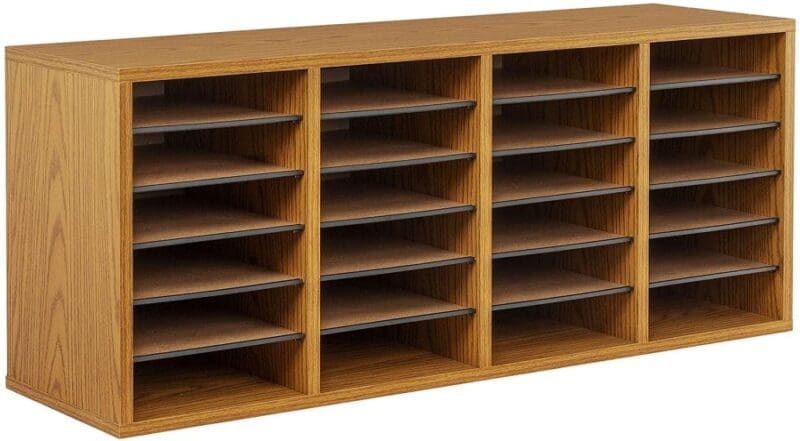
As a professional office organizer, I found that the majority of people sought my help because of the piles of paperwork that were encroaching on their workspace. Some clients had basic organizing skills, and often a fairly decent filing system, but were simply not making time to file their paid bills, completed projects, and so on. For the majority, however, it was not that simple.

Many visual thinkers are quite insistent that their paperwork must be in view at all times. Sometimes a desktop vertical organizer will work well, especially if it is slanted so that all the file labels are visible, but if your client has a large number of active projects, or if the files are very thick, it may not be very effective. Under these circumstances, the organizing product I recommended most often was a literature sorter.
As shown in the above photo, it consists of a number of sections, similar to the mail slots frequently seen in large offices. You can assign a specific topic or project to each section, affixing a label to the front of the shelf, and when your client receives a piece of mail or other document, he or she can quickly and easily put it away in the appropriate section. This ensures that all documentation related to a particular project is kept together, without having to dig through piles of paperwork on your desk to match them up.
Because a literature sorter is only slightly deeper than a sheet of standard letter-sized paper, it can fit on most desktops without taking up valuable workspace, but if your client has a smaller desk, you may need to place it on top of a filing cabinet, credenza, or small table located within their work area.
I’ve found that a literature sorter works well for all kinds of people. It works for “pilers” because it allows them to continue piling, but instead of having unidentified piles all over their desk (or office floor!), they have neatly organized and labelled piles, which also makes life easier for any associates who may need to find information when they are not in the office. People who like more traditional organizing strategies also like this system, because they can customize the sections to meet their individual needs, and easily modify them as their workload changes.
Literature organizers are manufactured in a variety of materials, including cardboard, plastic, wood, and metal, and in sizes ranging from 8 to 72 sections. Some of them are stackable so you can expand the system if needed. To view some of the products available, visit your favorite office supply store or see what’s available online.
If your client isn’t convinced that they can adapt to this system, they may wish to start with a cardboard version, and then invest in a sturdier product once they’re sold on the idea.
Do you have any other strategies for paper pilers?


I had a cardboard version that I used to store different types of paper in (mailing labels, cardstock etc). The movers unfolded the whole thing and packed it in a box when I moved. They took all the papers out of the cubbies and put them all mixed up in the bottom of the box!
Of course I didn’t have the instructions on how to re-build it but I finally got it back together correctly. It took me an hour to re-sort all the different types of paper into the correct slots.
Next time, I’ll tell the movers to PLEASE leave it in one piece!
I like the big black clips that can hold secure many pages together. They can hang from pegs on a cork board. This allows several projects to be out and visible (but not in piles on the desk) while being separated from each other. That way if more than 1 project ends up on the desk at once, they don’t get intermingled.
Jacki, I guess that’s one of the drawbacks of having the movers do your packing. 🙁
Karen, that’s a good idea, especially in a smaller office where a literature sorter might seem too bulky, or if the number of projects tends to fluctuate. It could also keep the cork board from getting cluttered with memos and other odds and ends!
Janet,
A favorite product I use a lot is the expandable collator. It collapses so I can easily take it with me on organizing jobs and it’s light weight.
Clients love ’em when working on projects.
Thanks for sharing that, Geralin. I Googled it to see what one looked like, and it wasn’t what I was picturing (which turned out to be an expanding project file). This would be perfect for organizers to carry with them, and would be a lot more versatile than traditional desktop organizers which don’t allow for expansion.
Thank you Janet for sending me this link, it will be very helpful for the client I was working with. You are awesome as always.
Glad to hear it, Grace! I was happy to help.
Thanks for the information. I found it very useful and I am really looking forward to seeing your posts in the future. Terrific blog.
Janet, loved this idea. I am a “filer” and I keep a rolling cart nearby, but I have a big “piler” sharing the office with me now and he has several projects going on, so I will give it a try with the cardboard option first.
Also like the expandable collator idea. I’m now working on papers with a client and this will help me work better.
Thank you for always sharing such useful and tested by the pros ideas! 🙂
I would love to hear how the literature sorter works out for your office mate!
Thanks for the reminder about this awesome system. It might work well for clients with ADHD Janet.
I hope you’ll report back if you try it with such a client, Jill.
Janet, I love this product! I set my husband up with one and a label maker in his office years ago and he still use it to this day! So much better than all of the piles of paper sitting all over the place and they were ALL OVER the place. Always great to be reminded of a great product!
Thanks for sharing your success story!
Thanks for the reminder, Janet! Sometimes you don’t need a fancy updated version, just a reliable system that has worked for years. 🙂
I’m sure a lot of people don’t have as many paper files as they did when I was organizing, but this is a great solution for those who do.
This product is my favorite way to organize active clients’ papers. I have a cabinet, and inside have lots of stackable in bins that do the same thing as the ones above, but I can close the cabinet and lock it for privacy.
Ooh, even better!
This product and others like it bring back so many memories. Early in my organizing days, this was a product I frequently used. It was especially helpful for people who were pilers and had a lot of papers. It created an excellent holding spot for specific categories and projects.
It was great! There’s a lot less paper these days, but it’s still out there, especially in certain industries. I found some interesting statistics that were really eye-opening!
Thanks for this Janet – it is a great idea. There may be someone in my house who needs this. 🙂 I love the idea of pegboard with the binder clips too.
I like that idea too – thanks for sharing, Kathy!
Thanks to everyone for sharing – I love having options to offer clients, so they can choose what works best for them. Appreciate this post, Janet!
I’m glad it was helpful, Carrie!