
The ‘AI-Powered Productivity Pod’ for the New Year: Designing the Ultimate Focus Zone for Remote Workers in 2026
This page may contain links to Amazon.com or other sites from which I may receive commission on purchases you make after clicking on such links. Read my full Disclosure Policy
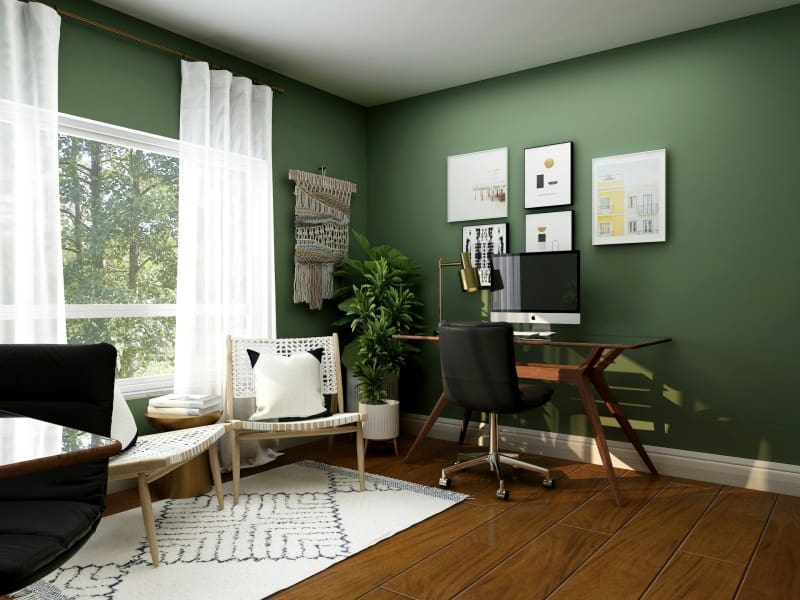
Creating a supportive remote work space can transform a person’s career. If you’re a professional organizer who wants to help your clients achieve their goals, integrate artificial intelligence (AI) into your project plans. Designing AI-powered workspaces could become a premium service for individuals who want to optimize their home environment and leverage technological advancements to streamline their workflows.
Understanding What Modern Remote Workers Need
Remote work has gained significant traction since 2019. The U.S. Census Bureau found that over 22 million people worked remotely in 2023, meaning that there is a significant market for clients who might need the perfect work-from-home environment. Creating the ultimate productivity pod depends on what best suits your clients.
People from varying socioeconomic backgrounds often work from home, so many likely lack an extra bedroom or space that can be converted into an office. You may need to think creatively to organize areas such as kitchen tables and living room corners.
Adaptive workspace technologies are the key to creating an optimal office environment in any household. AI will merge your designs with supportive technology that benefits remote workers across industries. Algorithms can also address other common frustrations for at-home professionals, such as the need for automated devices to handle tasks while they work and care for their families simultaneously.
Essential Features of an AI-Powered Productivity Pod
Focus-zone design will revolutionize how you help people organize their workspaces. Start by upgrading any physical elements that contribute to a client’s everyday stressors. Swapping recessed light fixtures with soft lamps or string lights could ease their anxiety if your client doesn’t enjoy intense illumination.
You might use AI resources to support your client’s sound management near their daily work area. Upgraded materials like wooden plantation shutters could block external noise that might otherwise distract them during video calls. Sync them with a smart motor so your customer can automatically close them on a schedule or with their phone.
Decor could also improve your client’s productivity. Houseplants can improve your cognitive abilities, which is crucial during work hours. Smart pots use AI to send alerts when each plant needs water. Your customers can use them as decor and as an additional source of AI support in their home office area.
Consider making custom pod profiles for each client. You could list their top concerns, the upgrades they appreciate the most and any goals they want to address in the future. If you align those notes with their selected office area, they’ll get an AI-boosted workspace that supports their long-term professional growth.
Steps to Create AI Productivity Workspaces
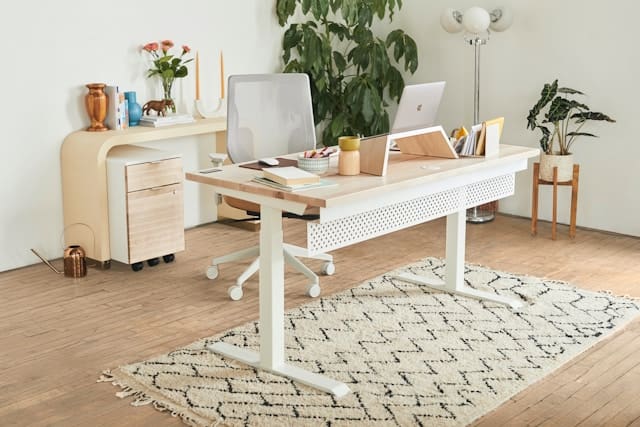
The exact techniques you’ll use to create an AI productivity workspace will differ for each client. Try these foundational steps to make the perfect remote workspace with smart devices.
1. Ask Detailed Questions
Develop a client assessment questionnaire to evaluate what they want from their upgraded space. You could make a step-by-step process that assesses their goals and inquires about any AI devices they’d like to own. Getting more details is better because you’ll feel confident when sourcing vendors.
2. Review the Budget
Remember to review your client’s budget while locating potential home office additions so you never lose sight of their financial goals. AI-powered technology may have a higher price tag than alternative models.
You may want to prioritize ergonomic seating. Early research suggests that as many as 86.3% of remote workers develop musculoskeletal conditions. A smart office chair may be outside your customer’s price range, but if you provide a spine-supporting chair while incorporating AI tools throughout the rest of the workspace, you won’t compromise the tech focus they desire while offering a beneficial option.
3. Assess the Work Space
Organizing a folding table in the corner of a living room is a different experience from redesigning an office that uses a guest suite. See what will fit in your client’s selected area, like task management smart boards or a printer that comes with predictive AI to minimize ink usage. Each organizational upgrade should meet your customers’ daily needs while being within their tech usage skill set.
Tips for Marketing Your New Organization Service
People may not be familiar with an AI-powered workspace unless they encounter a marketing campaign. Advertise your new offer by thinking about where your clients spend time and what they need. Researchers estimate that there will likely be 5.44 billion social networking site users by the end of 2025, so marketing yourself online could be productive. Create a visual campaign that includes videos of finalized high-tech spaces you organized for remote work environments.
You could also provide a quarterly service to refresh home office spaces with the latest AI tools. If you have more tech-savvy customers, they may appreciate getting the latest smart device models as soon as they hit the market.
Embrace Adaptive Workspace Technology
Providing AI-powered design ideas could transform how your clients experience their daily work. You’ll give them hands-free tools to conquer their to-do lists while personalizing their homes. If you have great reviews and an increase in consultation requests, you’ll know you’re on the right track with your ideal consumer base.
Photos by Collov Home Design and ergonofis on Unsplash
Looking for a place to brainstorm new service ideas—like AI-powered workspace design—and get feedback from peers?
Join POPS Circle and tap into a community that understands your work and supports your success.



Well that is a very interesting post! I have worked with clients to design remote work spaces, but haven’t given much thought to how AI might support and complement traditional approaches.
Light and sound management are key for those working from home. The ergonomic issues are also important. Sitting all day on a folding chair will quickly lead to trouble.
I imagine this will be an exploding category, with new products and services blossoming to help those working outside of a traditional office.
Now if AI can only keep the doorbell from ringing during a call LOL!
It wouldn’t surprise me to see that capability in the near future. 🙂
Hi Seana,
Thank you so much for your comment! I’m glad you found the post interesting. It’s really validating to hear from someone with your experience in designing remote workspaces.
I completely agree that light, sound management, and ergonomics are essential, and it’s fantastic that you prioritize those elements in your work. I see AI as an opportunity to amplify those foundational principles, and to personalize environments even further, especially in a remote environment.
Your point about AI assisting with remote work problems is spot on. I think we’ll see some really innovative solutions emerge in the near future to address those challenges.
Thanks for adding to the conversation, and I welcome any thoughts you have as you explore the possibilities of AI-powered organization!
I’m not sure what to say about this. It’s intriguing, without doubt. Rose has set the stage for what sounds, to me, like science fiction.
Sound, light, ergonomic set-ups — these have all been essential aspects of home office productivity since the beginning. Unless you’ve got a high-end medical AI that can measure a client’s body in 3D to find or design them the right chair for their spine and/or conditions, what can AI do here that we can’t? What AI tools can help with the ergonomics to combat musculoskeletal issues? (Good chair, good glasses, large enough font on the screen — where does AI come in?)
At the risk of seeming like a Luddite, taking the human element out of these kinds of tasks puzzles me. Why have plants if you’re not going to water them yourself? How hard it is it (and isn’t it better to get up and move your body) to close the shutters to block out sound? That’s not the kind of interruption that is going to negatively impact productivity (in the way a phone call might).
And who can really afford to implement the kinds of changes Rose suggests might be implemented? Surely not the remote workers whose socioeconomic status she acknowledges means they may not have dedicated rooms for work, and might have to use their kitchen tables. I don’t want to seem like a curmudgeon, but I’m hard-pressed to believe that AI-powered designs of remote workspaces will yield something that’s advantageous overall, let alone something affordable. Using AI instead of our brains to make these suggestions means we don’t have to be as smart and have more expertise than the average client (or the average AI). People will trade money for convenience, sure, but are we really expecting that more than a tiny minority of remote workers will have this kind of money to throw at *smart boards*? Most people are already dissatisfied with tech making decisions for them; consider the newest change to Zoom, where the software literally zooms in and out, pans left and right, and generally follows the individuals speaking as they move. It’s universally panned by participants, who get queasy, but the AI thinks we want to follow someone’s movements as they lean over to grab a water or pet their cat. Oy.
My fault is not with Rose’s ideas, but I guess with the notion that any of this is a net positive. I do not welcome our robot-brained overlords. Grumblegrumble. 😉
Hi Julie,
Thank you so much for sharing your insightful thoughts! I really appreciate you taking the time to engage with the ideas in my article.
I totally understand your skepticism about AI, and I agree that it’s essential to keep the human element at the forefront of our work as organizers. I definitely wasn’t suggesting replacing sound ergonomic principles.
My intention was to explore how emerging technologies can augment our existing expertise and potentially offer new solutions to some common challenges. For example, while a good chair is paramount, there are AI-powered tools that can remind users to adjust their posture, suggest optimal sitting positions based on pressure mapping, or provide biofeedback to improve ergonomic habits. It’s not about replacing our judgment, but about using data to enhance awareness.
You raise a really important point about accessibility. I agree that top-tier AI solutions might not be within everyone’s budget right now, but I believe the price point will decrease over time. More affordable AI applications already exist, and I think it will be essential for us to experiment with this emerging technology to determine what works for the majority of our clients. The same way that organizers have adapted other new systems into their business models, AI will be similar.
It’s a valid concern that AI could lead to over-automation or impersonal environments. I believe it’s crucial to prioritize human well-being and individual preferences when implementing any technology.
Thanks again for the comment, and I absolutely hear you on so many fronts. And it really means so much to me that you engaged with my post. It warmed my heart!
Rose
And thank you, too, Rose, for engaging. I appreciate your examples regarding more specific, concrete ways AI can enhance ergonomic awareness. For me, it’s reminiscent of early in the pandemic, when you could open a camera-enabling site that would sound an alarm if you touched your face.
Perhaps in one of your future guest posts, you can share even more of these specifics, which I believe allow us to better weigh the value of AI in potentially creating more productive spaces.
Mostly, I’m glad you understand that my issue is not with your approach, but with (what I feel is) the likely negative impact of AI in so many realms of our lives. Just call me Gramps! 😉
There’s no question that AI is here to stay. And with it’s rapid growth and little to no regulation, it’s hard to know all of the ways that it will influence and effect our future.
Using AI as a way to help with workspace planning is an interesting one. The human element will always been important, however, finding new ways to use AI as tool fascinates me. And you’ve shown some possible ways areas to explore.
It’s good to know what’s out there – even if you don’t try something, others might, so you need to be able to address it if a potential client asks about it.
I use AI almost daily but the most interesting way I have seen it applied to decluttering and organizing is to have chat GPT (or other AI tool) to show a client how their space would look after the clutter is gone! Best to take one small space – like a dresser, an ottoman etc. Having trouble finding the prompt right now, but I did get good results with it!
That’s amazing, Pam! If you happen to find the prompt, please come back and share it.