
Book Review: Year of No Clutter
This page may contain links to Amazon.com or other sites from which I may receive commission on purchases you make after clicking on such links. Read my full Disclosure Policy
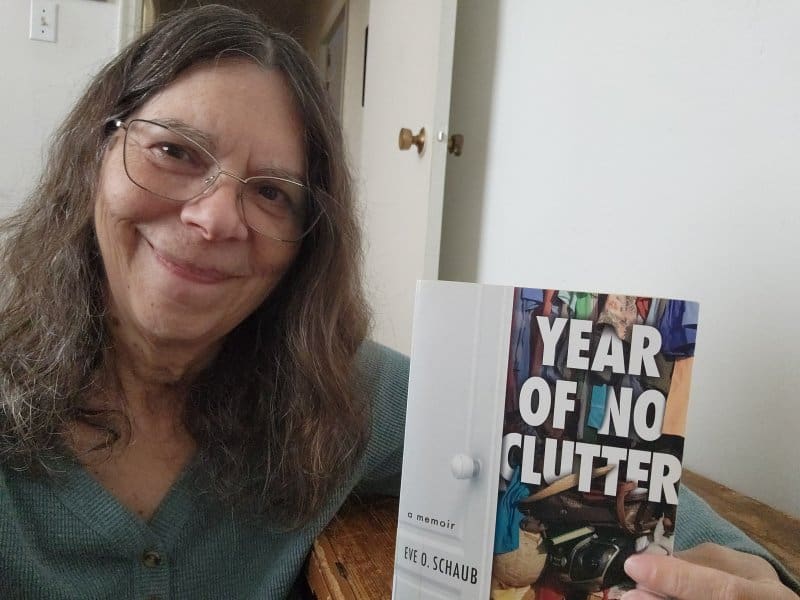
I discovered Year of No Clutter while searching for a memoir to read. I thoroughly enjoyed reading about Plum Johnson’s experiences clearing out her late parents’ home of many decades in They Left Us Everything, and although this book is about the author’s battle against her own clutter, I thought it might be similar.
Although both books are about the author’s experience dealing with clutter, that’s where the similarities end.
For one thing, Eve is a hoarder, or at least a person with hoarding tendencies. For the most part, her clutter is confined to a single large room, to which the door is kept closed. She calls it the “Hell Room,” and it holds an abundance of paperwork, craft supplies, and other assorted objects she’s amassed since childhood.
I found it interesting to read about how she tackled the Hell Room, made hard decisions, and formed close relationships with local consignment shops and charities. Even more fascinating was understanding why she kept certain things and how she managed to achieve what she did. If you help clients in similar situations, this insight may be helpful.
To my surprise, I related to Eve much more than I expected. While gradually letting go of things over the last few years, I’ve noticed that I’d kept a lot of things because I thought that’s what one did. I was actually shocked when one of my high school classmates told me she no longer had her yearbooks! Often, the longer I’ve had something, the more difficult it is to part with it.
Schaub identifies two reasons we keep Stuff (which she nearly always capitalizes):
- Nostalgia: fear of forgetting about past events without a physical reminder
- Potential: worry that the item will be needed again in the future
When viewed through this lens, I can identify exactly why I have nearly all of my keepsakes and other random items, and this awareness might help me make better decisions going forward.
Although I thoroughly enjoyed the book, I have to caution you – Schaub is essentially a humorous writer, so she puts a pretty light spin on the emotional roller coaster she was on during her decluttering project. You need consider only that her other titles are Year of No Sugar and Year of No Garbage to see that her primary goal is to entertain rather than educate. That said, I think there’s insight to be found in Year of No Clutter, though I probably wouldn’t suggest you recommend it to a client.



I think I would love reading this book. I hadn’t heard of it (or her others), so thanks so much for sharing. She’s got a very intriguing theme going there with the “year with no…”
I so agree that clutter has momentum. The longer we’ve had it, the longer it has been a part of our lives. We’ve grown our lives to include it, so removing it can feel difficult. The only exception is maybe old paperwork. I find the older the paperwork, generally speaking, the easier it is to let go. Half the time we either can’t read it or clearly no longer need it!
It doesn’t seem to be very well known. I was surprised when I looked it up on Goodreads and none of the organizers I follow seemed to have read it.
I totally agree that the longer we’ve had something, the more likely we are to hang onto it. I have theatre and concert programs from when I was in high school and university, but I stopped saving stuff like that decades ago.
Thanks for the clarification. Also, I think a lot of us have saved stuff from our youths — but they’re in our parents’ homes. 🙂 Mine are, and I’m always finding the same situation in my older clients’ homes.
Somewhere along the way, it shifts from our stuff being at our parents’ to their stuff being at ours… I didn’t leave much with my parents, but what I did got discarded,so I’m glad about that. 😊
I had to check my Goodreads list to be sure, because I was fairly certain I’d read this book, but nope. Perhaps I took it out of the library but never got around to reading it before I had to return it. I definitely didn’t know that it was a follow-up to They Left Us Everything, so that’s good to know.
You’ve made me curious, so I’ll be sure to add it to my TBR list, though I may become annoyed by the capitalization of “Stuff” for no apparent reason.
Clutter drags us down; the momentum starts when we move it OUT rather than just move it around. As for fear of forgetting, if a memory isn’t self-sustaining and we need a tangible object to keep the memory, why should we struggle and bother to keep the memory at all? We need to remember WHERE things are if we need them, but if we only touch the memories when we touch the items, of what use are those memories? I’m not keeping my high school geometry textbook so I can remember cosin and tangent; why keep things with memories attached if I don’t care enough about those things to use or display them in the present? (But that’s how I feel about my stuff; that’s not a client-centric approach.)
It’s not a follow-up to They Left Us Everything – sorry if I was confusing. I just thought they would be similar in nature.
I’ve been pondering the need for keepsakes to preserve memories myself. I remember a lot, but I wonder if it’s only because I’ve seen the photos and other mementos so often that it’s cemented them in my brain. If I hadn’t kept those items, would I have forgotten that trip I made with my friend when I was young? And if I did forget it, would it really matter in the big scheme of things? I just don’t know…
Thanks for the book review, Janet. Sometimes it is best to make light of a sad situation, like clearing clutter in a loved one’s home who died. I had to declutter and clear out both my parents’ estates, and it was pretty stressful.
That’s an excellent point, and the book was definitely more enjoyable to read with the humor than it would have been if it was totally serious.