
Book Review: “The Information Diet: A Case for Conscious Consumption” by Clay Johnson, O’Reilly Media
This page may contain links to Amazon.com or other sites from which I may receive commission on purchases you make after clicking on such links. Read my full Disclosure Policy
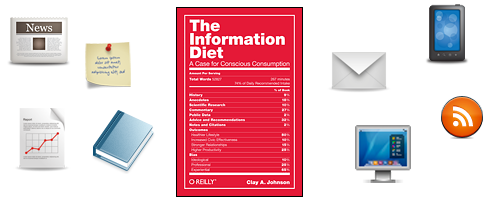
Every one of us is inundated with information on a daily basis, and trying to stay on top of it all is a never-ending battle. That’s why I was delighted to learn about the launch of a new book to help us deal with this growing problem.
Frankly, there’s a lot of related advice out there already – much of it including such phrases as “inbox zero” and “social media fast.” As a productivity expert, you may even have covered this topic in your own blog. But for Clay Johnson, the problem goes way beyond the amount of time and energy we spend reading emails, blogs, and social media posts. His concern isn’t just the quantity of information we consume, but the quality.
In the first part of the book, Johnson explains that just as eating highly processed food makes our bodies unhealthy, information that has been contaminated by the personal or political biases of the people sharing it is making our minds unhealthy. There’s also some fascinating historical background demonstrating that the “information explosion” is not something that started in the last 10 to 15 years, but has actually been occurring in stages over thousands of years.
I found the theoretical sections of the book quite eye-opening and well worth reading, but those who are anxious to get started on their information diet can go straight to Part II. Here, in addition to practical advice about scheduling times for consuming specific types of information, Johnson offers guidance for choosing “healthy” information sources that don’t just confirm our existing beliefs, but open our minds to new ideas and help us to focus on things that really matter. His teachings tie in quite well with the TED video of Eli Pariser I saw earlier this year, with many references made to Pariser’s book, The Filter Bubble. (On a side note, one of the other books which Johnson recommends is Dan Ariely’s Predictably Irrational: The Hidden Forces That Shape Our Decisions, which has been sitting unread on my bookshelf for well over a year!)
I was so eager to begin my information diet that I began making changes to my daily routines even before I finished reading the book, and intend to continue fine-tuning them in the weeks and months to come. I’m hoping that those of you who follow me on Twitter or other social media sites will find that my new habits help me to share even better information than before, but just as you can’t switch from being a “junk food junkie” to a “health food nut” overnight, it will be a work in progress. 🙂
Being neither American nor politically inclined, the frequent references to American politics weren’t really up my alley. On the other hand, I now feel better equipped to filter through the B.S. and understand the connection between politics and my role in society, and that’s quite an accomplishment.

In summary, I read The Information Diet to get some tips for remaining “smart, productive, and sane” (as described on the publisher’s website) and came away with even more than I bargained for. I highly recommend it if you find yourself overwhelmed by the constant flow of information or advising clients who struggle with this issue.
I recommend...






Thanks for an informed review, Janet. This book sounds like a must-read for an info junkie like me.
You’ve just given me permission to unsibscribe from a cople of lists that I’ve been feeling like I “should” understand but don’t. They’re goners now. And the time I’m not spending there can be used to read info that is actually useful to me.
thanks again!
Always happy to help!
Hi Janet!
Looks like an interesting book! Information overload is a big topic! Interesting to think of it as a ‘diet’ to go on. As a minimalist, you know I like to reduce the barrage of information that I allow to filter through me so this conscious consumption idea appeals to me.
I am rarely a reader of books to be honest, although I am currently a university student so I’m consuming enough academic literature to make up for it! This addresses the reduction of physical clutter (any books I do have are electronic) as well as limiting the amount of escapism. Any down time I have I would rather socialize, write or meditate. Although I don’t have television, I do watch the occasional movie to transport me into the lives of others, fictional or not. This might be a time saving strategy – it takes less time to watch a program than to read a book ;-p
However, it is important to keep up with the news! I am sensitive to the plight of many who are affected by natural disasters to cultural clashes to systemic prejudice… Therefore I try to pay attention to what is happening politically and socially so I can figure out where and when to contribute. Yet, there is SO much skewed and sensational information out there that can unfortunately overwhelm people. They then may choose not to participate and that can lead to apathy which isn’t good for our societal growth. My minimalist solution to the time consumption aspect is to get Twitter highlights from trusted sources and not watch television news or listen to radio. (it is all so dramatic!) I also have a select group of politicians, reporters and community programmers that I follow to get the ‘on the street’ perspective. I will also ‘click’ further to get updated on science and medicine, as well as on individual stories to learn about personal experiences and their history.
Then there’s email and social media. I have established boundaries around these for a long time. I enjoy ‘app contact’ (I love to blog and put up photos on Instagram) but Facebook can really suck the life out of you! Haha! I consider it important for connection time in some ways but I have to be judicial in how much I stare at it. Emails I have a much easier time with. I rarely subscribe to things and I have a tight management system for organizing my daily inbox, as well as the time of day I look at it.
One other category to consider – advertising! Flashing signs, posters, flyers all along the street, in the transit system, offices etc. We can’t forget to factor in the amount of unsolicited information we are exposed to.
So quality of content and the amount, as well as timing of viewing seem to be my three themes here. They are likely dealt with in this book. It would be interesting to see what they say about the neuroscientific findings! Tempting…but I’m still not going to read it – Lol!
Jo
Well, Jo, it does sound like you have a very good handle on things, so reading this book (which is available as an e-book, by the way), would probably not be the best use of your time! You may, however, find it worthwhile to explore http://resources.informationdiet.com/ for help identifying good sources of information.
Yes! There are some good resources there – one being a link to a blog post on the importance of boredom! 🙂 Another reason to remove the information clutter and allow our minds to wander.
I look forward to reading about your diet changes 😉
Jo
For quite a while I had a rule (filter) set up in Outlook to automatically put newsletters into a Reading folder. Once a week or so I would blitz through it, but when I got very busy, it would get out of hand and I’d delete a bunch.
I’ve recently eliminated the rule, and now I quickly look at the emails as they come in and decide whether to read it now, save it for later, just delete it, or remove myself from the list.
It’s definitely a work in progress!